Advice for Parents: What Your Kids Really Need From You

I just finished writing about marriage advice for newlyweds, which got me thinking about the challenges couples face. And one of the biggest? Parenting.

It’s one of life’s greatest joys. It’s also one of life’s greatest stressors. Ask any parent who’s been through sleepless nights, teenage rebellion, health scares, or just the daily grind of keeping tiny humans alive and functioning, and they will tell you I’m right.

I raised two kids while building a career and dealing with my own complicated past—fourteen years in an orphanage after being abandoned at age three. My son battled leukemia. My daughter went through her share of struggles. And I had no model for what a good father looked like because the people who should have shown me walked away when I was three years old.

So when people ask me what advice to give new parents, here’s what I tell them. These are the tips for new parents I wish someone had given me—the things I learned about being a good, loving parent despite the stress and chaos.

Children Want Two Things: Opportunities and Boundaries

This might be the most important thing I can tell you about raising kids. Children want opportunities to grow, but they also want boundaries. They need both.

Give them opportunities to explore, experiment, and succeed. But also give them boundaries. Clear ones. 

And here’s the thing: they’re going to test those boundaries over and over again. Not because they’re trying to push your buttons, but because they’re testing them to make sure they’re real. Those boundaries give them comfort.

Setting Boundaries Is an Act of Love

I’ve spoken to kids all over the world in juvenile detention centers, group homes, and crisis centers. You want to know what those conversations taught me? That even the toughest, most independent kids want to know that someone loves them, and what they really needed, going back to what I just said, were boundaries. 

Now a lot of parents don’t want to set boundaries because it makes the child upset. They think, “I love them and I want them to feel good, so I won’t say no.”

But what you’re really communicating with a reasonable boundary that you set and enforce is love and care. You’re saying, “I want better for you than what you’re going to choose for yourself right now.” 

That’s real love. That’s real respect. And through that boundary you’re also instilling self-respect in your child, because you’re teaching them how they should be treating themselves. You’re teaching them to say down the road, “No, I’m not going to do that because I want better for myself.”

Give Them the Opportunity to Talk Openly and Honestly

Now that we’ve gotten clear on the value of providing your kids with boundaries, let’s talk more about giving them opportunities. One of the best opportunities you can give your kid is the opportunity to talk to you openly and honestly.

That doesn’t mean grilling them with questions until you get the answers you want to hear. It doesn’t mean forcing them to tell you things on your timeline and your terms. What it means is giving them opportunities to share with you in a way that feels safe and on their timeline.

Here’s how I would hold this space for my kids.

I remember picking up one of my kids from school, and I could tell they were in a funk. I would ask “How was your day?” and I’d get the silent treatment, or a dismissive “Quit hassling me.”

So I’d drive to their favorite ice cream place without saying a word. “What are we doing here?” “We’re getting ice cream. You got a problem with that?” We’d order, sit down. They might not talk at all.

Then we’d get back in the car, and I’d keep driving further from the house.

“Where are we going?”

“I don’t know. But I’ll keep driving till you’re ready to talk.”

“You’re serious?”

“I’m very serious. I’m going to keep driving, and I’ll give you the time and space you need to talk to me and get your words out so they don’t eat you up inside. I’m not going to ask a question. I’m just going to keep driving till you feel ready to share.”

One time we drove for an hour and a half before those words finally came out. Was it important? Not really. It was some junior high boy drama and my daughter was caught in the middle of it. But she got it all out. And when we got home, I said, “I’m sorry your heart is broken. I love you.” And that was it.

Don’t let a kid who’s struggling and shut down just sit on the couch and play video games, or shut themselves in their room and suffer in silence. Give them the opportunity to share with you, openly and honestly. As a parent, you don’t have to have all the words. Sometimes they don’t even know the words to say. Just hold the space open, give them the opportunity to share, and wait for the right moment.

You’re Not Going to Be Perfect

I don’t want to give the impression that I was a perfect parent. I wasn’t. I made mistakes. I lost my temper when I shouldn’t have. I was too strict sometimes and too lenient at others. 

But I learned that parenting isn’t about being perfect. It’s about being present. It’s about giving opportunities and setting boundaries. It’s about paying attention even when they don’t want you to. It’s about doing what’s best for your kids even when it frustrates them.

And it’s about remembering that the chaos and stress? They’re temporary. But the relationship you build with your kids through all of it—that lasts forever.

Marriage Advice for Couples: You’re Teammates for Life

February gets people thinking about hearts and flowers. I’ve been thinking about 45 years of marriage, which includes some hearts and flowers, but also includes sleepless nights with sick kids, financial stress, personal struggles, and seasons where we weren’t sure we’d make it through.

If you’re newly married or thinking about getting married, you probably don’t need another list of generic marriage advice for newlyweds. You need the truth. You’re not just partners in romance. You’re teammates in life. And like any good team, you’ll have moments when one of you is carrying more weight, seasons when you’re growing at different speeds, and times when you have to pull each other up and work hard to keep pace.

So here’s what I’ve learned about making a marriage last after 45 years.

The Light Ahead of Me

When I met my wife in college, I was a mess. I’d spent fourteen years in an orphanage after being abandoned at age three, aged out at seventeen, and spent the years after that trying to drown my bitterness in everything I could get my hands on. I was angry, broken, and convinced I was doomed to become exactly what my past said I’d become.

But when I met her, something shifted. I knew I wanted to be a better man for her. Not perfect—I was nowhere near perfect—but better. She became a light ahead of me, pulling me forward toward the man God believed I could be instead of the man my circumstances said I was stuck being.

That’s what a good marriage does. When one of you is growing, reaching, striving to become something more, the other becomes that light ahead, helping you walk into it. And then the roles reverse. You grow in an area where your spouse is struggling, and you become the one pulling them forward, with patience, encouragement, and a lot of love and grace along the way.

You’ll Wound Each Other—Sometimes Without Meaning To

I’d lie if I said our 45 years have been easy. We’ve had some awfully hard times.

Here’s something most people don’t talk about: sometimes in a marriage, a person has their own problems, and those problems wound their partner. They’re not wounding their partner on purpose. They’re just having their own problems. Maybe one of you is dealing with depression, anxiety, unresolved trauma, career stress, or health issues. You’re not trying to hurt your spouse, but your struggle affects them.

That’s when you most need to remember that you’re on the same team. The problem isn’t each other. The problem is the problem. And you tackle it together.

My wife and I have had to learn to say, “Time out. We’re not enemies here. What are we actually fighting?” Sometimes it was financial stress. Sometimes it was exhaustion from raising kids. Sometimes it was navigating one of life’s low points together. But no matter what life throws our way, we always come back to the same truth: we’re teammates.

The Biggest Mistakes I See Couples Make

After counseling men for nearly 23 years through CBMC and working with couples on estate planning, I’ve seen patterns in what breaks marriages apart. Most of it comes down to unrealistic expectations that were never discussed before the wedding.

First, skip premarital counseling and you’re setting yourself up for problems. Good premarital counseling forces you to talk about the hard stuff before you’re legally bound to each other. How will you raise kids? Who manages money? What are the expectations when he’s exhausted from work and you’re exhausted from keeping a human alive all day?

Set clear expectations on issues like these before you get married.

Second, refusing to go to counseling when you hit hard times. Sometimes you need that third party to let you say the words out loud that you shouldn’t say directly to your spouse in the moment. Get it all out to someone who can help you refine it, then bring you back together to work through it.

I’m not saying counseling solves everything, but sometimes you have to look at each other and say, “Together we’re not solving this. Let’s get help.”

Third, forgetting why you chose to get married to each other. In the hard times, you need something to come back to. You need to remember why you got married in the first place.

Ask yourself: What attracted us to each other at the start of our relationship? What did we used to love to do together? What kind of husband did I want to be when we first got married? What were my goals as a newlywed wife? How can we get back to being closer together?

Reflect on these questions together. Remember what was once at the core of your relationship. Talk about it without accusing each other of failing to live up to some ideal. Just talk about who you were and who you wanted to be together.

The Beauty of the Long Haul

After 45 years together, I can tell you that the best part of a marriage isn’t the anniversaries or the vacations. It’s that you build an entire life together—not just a home or a family, but a life.

You don’t have to worry about being known or seen by your partner because they’ve been with you through so much. They’ve seen every side of you—the good, the bad, the side that comes out at 2 a.m. when the baby won’t stop crying, the side that shows up after you’ve lost a job or buried a parent. They know you, and you know them.

Living life with your partner becomes second nature. They become a part of you. You prioritize their needs without thinking about it because their needs are your needs, and vice versa. That’s moving through life as one unit instead of two people trying to coordinate. That’s intimacy—not just romance—true intimacy. 

It’s a powerful, beautiful relationship. One of life’s greatest joys, despite the challenges along the way.

And here’s the beauty of those challenges: every one you face and overcome together makes you stronger. Every hard season you push through weaves another thread in the fabric of your marriage. You become unbreakable not because you never face problems, but because you’ve proven to each other that you can face anything and still choose each other on the other side.

My Advice to You

So if you too want a marriage that will last 45 years and beyond, here’s what I believe matters most:

Get away when you can. A night, a weekend if possible. Reconnect not just as parents or roommates, but as partners. Remember why you chose each other.

Be willing to go to counseling, separately or together, when you need it.

Talk about expectations before they become resentments.

And remember you’re on the same team. When one of you is in a low season, the other pulls them up. When one of you is growing fast, the other works to keep pace or reaches for that light ahead.

That’s what 45 years has taught me.

How to Keep Your New Year’s Resolutions and Change Your Life

I know what you’re thinking. New Year’s resolutions are a joke. You’ve tried before. Lost weight until March. Quit smoking until your next crisis. Read your Bible every day until life got busy. Same promises, same failure, every single year.

So why am I telling you January is a great time to change your life?

Because I’m not talking about resolutions. I’m talking about real change. And yes, there’s a difference.

The Problem Isn’t the Timing

After building something from nothing—going from abandoned at three and homeless at seventeen to where I am today—I can tell you the problem isn’t that people try to change in January. The problem is how they try to change.

Most people make promises they can’t keep, try to overhaul everything at once, and rely on willpower instead of having a real plan. When they inevitably fail, they blame themselves for not being strong enough, disciplined enough, committed enough.

But I need you to hear this: strength has nothing to do with it.

Why January Can Work

Think about it. January is one of the few times in life when everyone around you is thinking about change. Your coworkers are talking about their goals. Your friends are asking for accountability on their resolutions. There’s collective momentum toward improvement.

That’s not a cliche. That’s an opportunity.

Because when you’re trying to make a difficult change, you need every advantage you can get. Why would you ignore the one time of year when the whole culture is leaning in the same direction you’re trying to go?

But here’s the key: you can’t approach it the way everyone else does. Because most people are setting themselves up to fail.

What Real Change Requires

After decades of working through my own changes and watching others do the same, here’s what I know: sustainable change happens through small, actionable steps that fit into real life.

Not big declarations. Not dramatic overhauls. Small steps.

Let me tell you why. When I teach financial planning, I use something called the Debt Snowball method. If someone’s drowning in debt, I don’t tell them to attack the biggest balance first. I tell them to pay off the smallest debt, get that win, and build momentum.

Why? Because success creates confidence, and confidence creates more success.

The same principle applies to any change you want to make in your life.

Where Most People Go Wrong

Most people set themselves up to fail by trying to tackle too many areas of change at once.

Friend, you don’t need to make a grandiose list of everything you want to change. Start with a handful. Even better, start with one thing. What’s most important is that one thing is actually doable.

I use this strategy in my own business with my teammates, I don’t call my employees “employees”.  I always give my teammates a little way to succeed instead of one big way to fail. 

Why? Because every time you succeed, you’re weaving threads in the tapestry of your confidence in your competence.

Read that again: confidence in your competence.

When you accomplish something—even something small—you’re proving to yourself that you can do this. That’s a thread. When you do it again, that’s another thread. Each win weaves another thread. Each thread makes you stronger. Eventually, you’ve built something that can hold weight. Eventually, you’ve built up enough strength to stick to the changes you want to see in your life.

That’s what most people miss. They think change requires superhuman willpower. What it actually requires is a series of small wins that prove to yourself you’re capable. One thread at a time.

The Question You Need to Answer

Before you can change anything, you need to get honest about what actually needs to change. Not what sounds impressive. Not what everyone else is working on. What needs to change in your life.

This is the step most people skip. They jump straight to “I’m going to lose 30 pounds” or “I’m going to read the Bible every day” without ever stopping to ask: why? What’s actually broken? What’s holding me back? What would my life look like if I changed this?

And here’s the harder question: what order should I tackle these things in?

Because if you’ve got five areas of your life that need work, you can’t fix all five at once. You have to choose. You have to prioritize. You have to build a plan that’s actually doable.

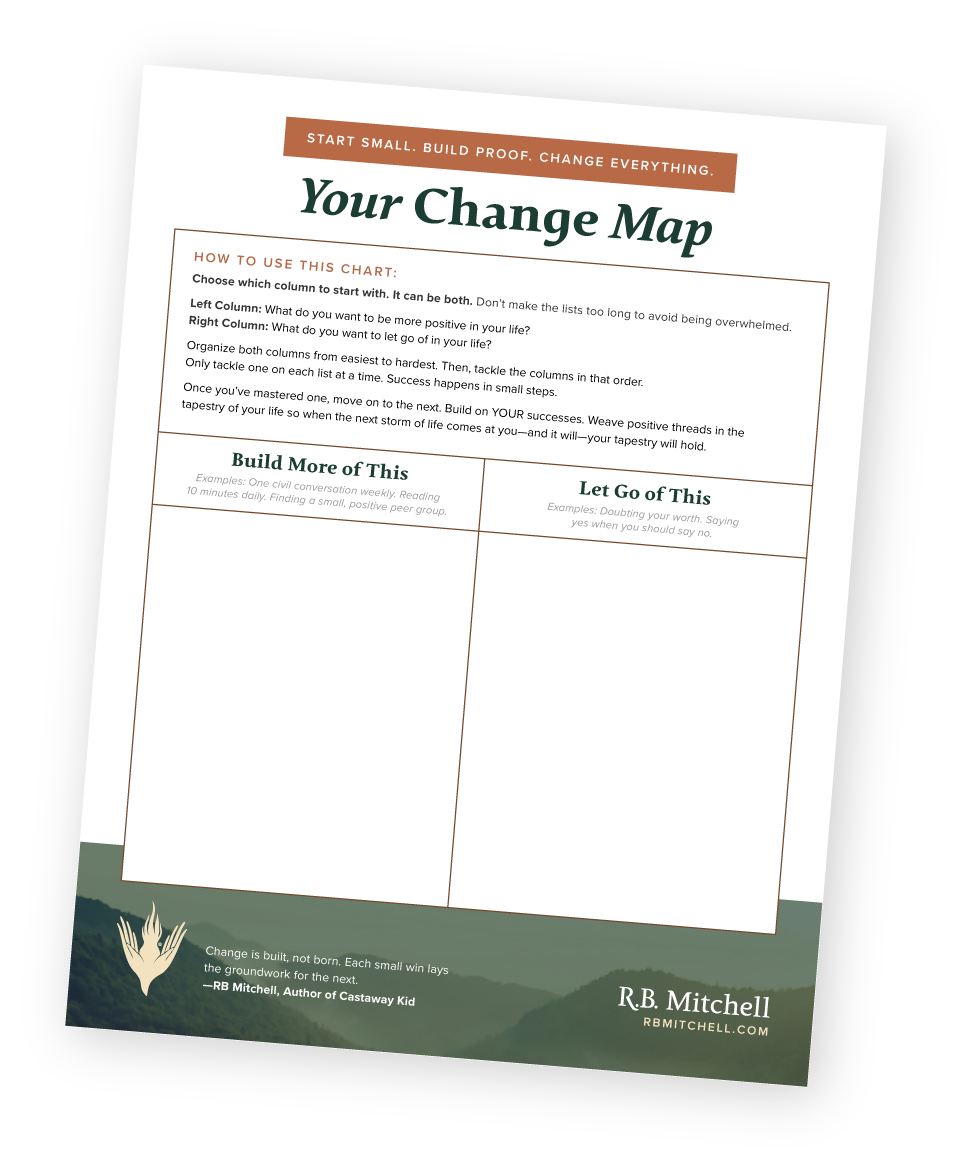
That’s why I created Your Change Map.

How to Make Change Stick

Your Change Map is a simple tool that helps you do three things:

First, it helps you identify what you actually want to change. Not surface stuff. Real change that matters.

Second, it helps you structure those changes in the right order. The order that makes sense for your life, building momentum instead of overwhelming you with everything at once.

Third, it gives you a framework for taking small, actionable steps toward the life you want. Not someday. Not eventually. Starting now.

This isn’t another journaling activity you’ll do once and forget about. It’s a practical guide for people who are tired of making the same promises every January and abandoning them by March.

You can download it for free here. Use it in January. Use it in July. Use it whenever you’re ready to stop talking about change and actually do something about it.

What Makes This Different

Let me be clear about something: Your Change Map isn’t magic. It’s not going to change your life for you. You still have to do the work.

But here’s what it will do: it will give you a clear path forward when everything feels overwhelming. Instead of trying to fix everything at once, you’ll know the next right step to take. 

You won’t make the same mistakes most people make when they try to change, because you’ll have a framework that actually works. Because the goal isn’t to become a different person overnight. The goal is to become a slightly better version of yourself, consistently, over time.

That’s how real change happens. Not through big declarations. Through small steps, taken repeatedly, in the right direction.

If You’re Ready

If you’re reading this and you’re tired of being stuck, tired of making the same promises, tired of watching another year go by without real change, then maybe you’re ready.

Ready to stop relying on willpower and start following a plan.

Ready to stop trying to change everything and start changing something.

Ready to stop beating yourself up for past failures and start building momentum toward future success.

January is a great time to start. Not because there’s anything magical about the calendar. But because you’re thinking about it right now. And right now is always the best time to take the next step.

Download Your Change Map. Identify what needs to change. Structure your plan. Take one small step.

Then take another.

That’s how you build the life you want. One step at a time, starting now.