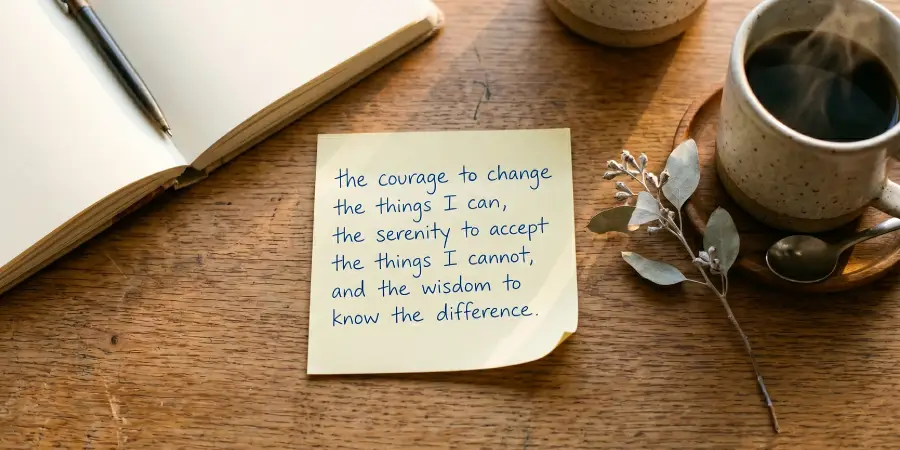
There is a prayer I have taped to one of my screens. I’ve had it there long enough that I sometimes stop seeing it, the way you stop seeing anything that becomes part of the furniture of your daily life. But about fourteen years ago, I had to build something around it consciously, because there was something happening in my life that I had no control over and my unhappiness about it was not helping me at all. It was consuming me in the background of everything else I was doing, and I needed a way to put it somewhere.
I call it my serenity box.
What I Did With Hopelessness as a Child
I want to be honest about what I did not have growing up, because it’s part of understanding what I eventually found.
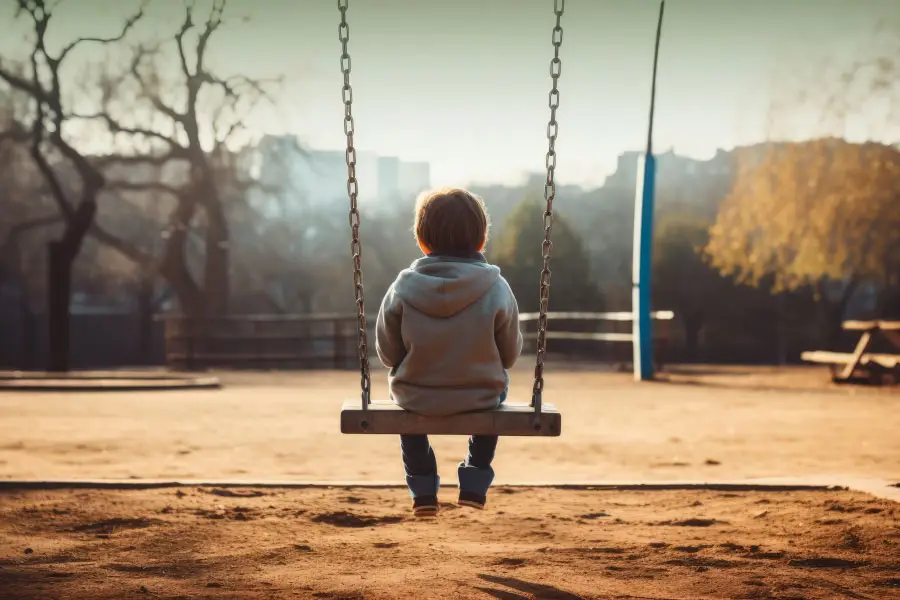
In the orphanage, when hopelessness hit, my coping consisted mostly of isolation and endurance. I shut down at seven after a family member I loved refused to take me home, and I lived in that shut-down state for the better part of a decade. That was the mechanism available to me. Lock the door, stop feeling, wait it out. It kept me functional. It cost me something too, though it took years to see that. When you numb the pain, you numb the rest as well, and I spent a long time not feeling much of anything in either direction.
I did not have a prayer then. I did not have a support system. I had sixty-three other kids in the same building, most of them carrying the same things I was and none of us with the language to say so. What I had, by the time I was a teenager, was a slowly building anger that at least kept me moving, even if the direction it pointed me wasn’t always good.
Then, the fall of my senior year of high school, something changed in me that I could not have explained and did not hear announced by any dramatic sign. I just knew it had happened. That was the beginning of something that would eventually give me a different relationship with hopelessness, though the full shape of it took years to understand.
What Hopelessness Looks Like Later
People who grew up hard sometimes assume that if they make it through the worst of it, hopelessness stops being something they have to deal with. In my experience, it doesn’t disappear so much as it changes shape.
In adulthood, hopelessness tends to attach to specific things you cannot fix. A situation that has gone wrong and will not right itself no matter what you do, a relationship that has deteriorated past the point where your effort connects with anything, a circumstance that simply is what it is, and you are the one who has to keep living inside it. The feeling underneath it is familiar from childhood, that sense of being up against something immovable, but the adult version has more texture, because now you understand more clearly what you’re losing and you can name it.
Fourteen years ago, something in my life that I had no control over was causing me a level of unhappiness that was starting to affect everything around it. I was carrying it into situations where it had no business being. I couldn’t stop returning to it, even when returning to it accomplished nothing. That is when I built the serenity box deliberately, not as a concept I believed in intellectually, but as an actual practice I had to return to, the same way you return to forgiveness, and any decision that doesn’t stay made on its own.
What the Serenity Box Actually Is
The serenity box is not a physical object. It is a mental container I built for the things I have no control over and my unhappiness about which is doing nothing useful.
When the ruminations start, when my mind starts going back down the same rabbit trail toward the same thing I cannot change, I have to consciously return to the prayer and ask myself the question it contains: is this something I have control over? If the answer is no, then my unhappiness about it is something I am doing to myself. Not something that was done to me, not something I am owed relief from, but something I am choosing to keep doing by refusing to put it in the box and leave it there.
That sounds simpler than it is. I want to be clear about that. I have the serenity prayer taped to my screen and I still have to remind myself to use it. The brain returns to what it knows, especially the things that hurt it, and the practice of interrupting that return and redirecting it is not something you do once and finish. It is something you do repeatedly, sometimes multiple times in the same day, for as long as the thing you cannot change is still something you care about.
What helped me build that practice was not willpower alone. It was the combination of the prayer, which gave me a framework for sorting what was mine to carry and what wasn’t, and the people around me, primarily my wife and the support that had gradually accumulated in my life over the years of my marriage, who could sometimes see more clearly than I could when I was letting something eat at me that I had no business holding onto. That support was still being built in those years. It was not solid ground yet. But it was there, and it helped.
Coping With Trauma When You Can’t Let Go
If you grew up with trauma, anything that happened to you that you had no choice about and no power to stop, then you already know what helplessness feels like from the inside. The orphanage was not something I could negotiate with. My parents’ brokenness was not something I could fix. The family members who chose not to take me home were making decisions I had no access to. I was a child, and the things that shaped my childhood were entirely outside my hands.
What I did not expect was how quickly that same feeling could return in adulthood, decades later, when something happened that I could not fix. It did not just feel like the current problem; it felt like the old one. Like the thing you need most is once again simply not available to you, and all the years in between don’t seem to count for much. That, as much as anything, is what coping with trauma actually looks like in a grown adult. Not a memory. A present-tense experience that the present moment has simply given an excuse to surface.
Letting go of what you can’t control is not a one-time decision. It is a practice, and the serenity prayer is useful precisely because it interrupts that loop before it runs very long. It doesn’t ask you to feel better, it asks you to sort. Is this mine to change, or isn’t it? That question takes you out of the spiral and puts something concrete in front of you. It asks you to find the courage for the first category and the acceptance for the second, which are two very different skills, and neither of which arrives fully formed. I am still working on both.
Rebuilding Hope After Trauma
Finding hope again after it has gone isn’t something that happens by deciding to feel differently. That never worked for me. What actually changed things was a slow, sometimes uncomfortable process of sorting what I had control over from what I didn’t, and then doing something about the first category instead of ruminating on the second. Ruminating and acting are not the same thing, and it is easy to spend years mistaking one for the other.
The things I couldn’t change, I had to learn to put in the box and leave there. Not without grief, not without wishing things were different, but with a growing acceptance that my unhappiness about them was the one thing in those situations I actually did have some say over. The things I could change, I had to stop just thinking about and start doing something with. Over time, enough forward motion in the things within my reach meant the things outside of it stopped taking up quite as much space.
That is not a triumphant recovery. It is uneven and some days barely feels like progress, but it is the only version of rebuilding hope after trauma that has ever struck me as honest.
There are things in my past that I still wish had gone differently. I expect I always will. They are in the box, which means I have made my peace with not being at peace about them, and I have pointed my attention toward the parts of my life where my effort actually connects with an outcome.
That is the best I can tell you. Some days it is enough, and some days it is barely enough, and either way it is what I have.
In Hope.