
Nobody in the history of the world has ever chosen their biological parents. That is an absolute truth. You did not pick the family you were born into, the circumstances you inherited, or the things that were done to you before you were old enough to have any say in the matter.
You also cannot change what has already happened. Not what others did to you, and not what you’ve done to yourself.
What you can choose is how you act and how you react from this point forward. Those are yours. They have always been yours, even when it didn’t feel like it, even when everything around you suggested otherwise. That is where healing either begins or stays stuck.
I didn’t realize this overnight. I realized it by paying attention to the way people flinched when I asked the wrong thing, and by remembering what it felt like to be on the other side of questions I wasn’t ready to answer.
What I Was Carrying at Seventeen
I walked out of an orphanage at seventeen with a garbage bag of belongings and nowhere to go. By that point I had spent fourteen years being shaped by things I did not choose, a mother who couldn’t stay, a father who tried to end his own life, adults who gave me half-truths when I asked why I was there, and older boys who used the smaller ones to violently manage their own pain. I was angry in the way you’d imagine, and I was making choices that were heading me toward the same line almost every boy in that building was going: prison, or a grave.
What I didn’t know then, and what took years to figure out, was that the anger was not the problem. The anger made sense. It was the right response to what had happened. The problem was that I was letting the anger make every decision for me, and I was confusing that with having no choice at all.
The shift didn’t come as a single moment. What formed over time was an understanding that my circumstances were not my sentence; that I owned my actions and reactions, even the ones I got wrong, and that owning them was different from being defined by the things that had been done to me by other people.
That conviction had to be tested. It is still being tested. But it was the beginning of breaking the cycle, and everything that came after grew from it.
If You Name It, You Can Face It
I’ve spoken in forty states, in juvenile detention centers, in group homes, in churches, in corporate offices, and in underground churches on two continents. When I’m in a room with people who are stuck, especially young people who have been through things they didn’t ask for, I come back to a phrase I’ve used for decades.
If you name it, you can face it. If you face it, you can rise above it. But if you lie to yourself, you have no hope.
Those three go together. You can’t skip one and still arrive at the next.
Naming it means being honest about what is actually going on in your life. Not the version you give people when they ask how you’re doing, but the version that is true. Whether you drink more than you should, or you’re still angry at your father, or you haven’t forgiven the person who hurt you, or you’re scared you’re going to turn out like your parents, which is how I was. Whatever it is, it has to be called by its name, and you have to be willing to look at it directly before you can do anything about it.
I’ve watched people spend decades avoiding this step. Naming the thing makes it feel more present than it already is, and the fear is that you can’t handle it if it gets any closer. But the thing is already present. It’s already running your decisions, whether you’ve named it or not, and all you’re doing by naming it is being honest enough to stop pretending otherwise. That is where the work of trauma healing starts, and there is no shortcut for that.
Facing It Is Where It Gets Harder
Naming something is an act of honesty, and facing it is an act of courage, but the two are not the same.
Facing it means sitting with the thing you’ve named long enough to figure out which parts of it are yours to do something about and which parts aren’t. That distinction turns out to be one of the hardest things a person can learn. Because when you’ve been hurt, when someone else’s choices broke your childhood or your family or your sense of who you were going to become, the pain feels like one solid mass. It’s all tangled together, what they did, what you did, what happened as a result, what’s still happening now. Separating the parts you can control from the parts you can’t is tedious, uncomfortable work that nobody wants to do and that no amount of anger will do for you.
What I had to come to terms with, eventually, was that the things that happened to me in that orphanage were not my fault. But the life I was building from that point forward was my responsibility. Most people I’ve worked with get stuck, not because they refuse to name the thing, but because they haven’t separated what was done to them from what they’re going to do about it.
The T-Chart
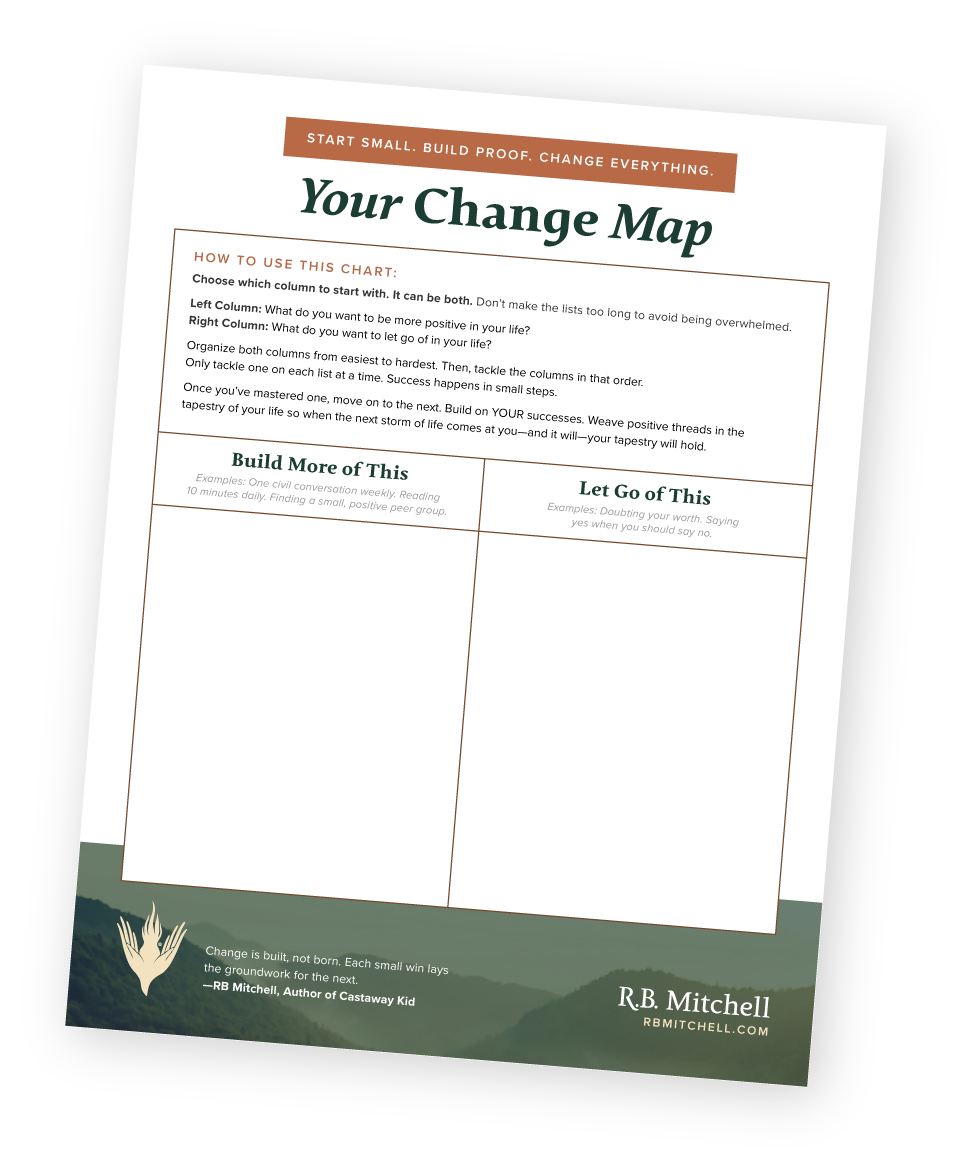
I created a tool years ago that I still use and still recommend. It is simple enough that a teenager can do it and honest enough that a forty-year-old will avoid it because it’s uncomfortable.
Draw a line down the middle of a piece of paper. On the left side, write what you want more of in your life. On the right side, what you need to let go of. Don’t make either list long. Start with what’s obvious, and be honest about it. If you lie to yourself, you have no hope.
Organize both columns from easiest to hardest, and start with the easiest item on each list. Not the biggest, or most dramatic, the easiest, because succeeding at a small thing gives you proof that the next small thing is possible, and proof is what moves a person forward when motivation runs out.
I lost almost forty pounds using this same principle. I named the problem, I faced it honestly, and I started with the smallest step I could take, which was an app on my phone that tracked what I was eating. One pound a week. It wasn’t dramatic, or inspiring, but it was consistent, and the consistency built proof over time that I could actually do this.
Moving forward after trauma works the same way. Not in leaps, but in accumulated proof that the story your past told you about who you were going to become was not the final word.
What Breaking the Cycle Really Looks Like
People use the phrase breaking the cycle, which sounds clean. It’s not.
For me, it meant deciding I was not going to be like my parents. That I was going to stay married even when marriage was difficult, and I was going to be the father to my kids that nobody had been for me, and I was not going to drink my way through the pressure or walk away from the people who needed me. But making those decisions once was not enough: I had to keep making them, for years, on the days when the old patterns showed up in full force and the decision felt like the hardest thing I’d ever done.
I made mistakes along the way. Plenty of them, and some of them I didn’t recognize as mistakes until much later. Moving forward is not a straight line, and the setbacks can feel like proof that nothing has changed when in fact they’re just evidence that this is hard.
What I can tell you from decades of living this is that the setbacks do not erase the progress. The days when it feels like nothing has moved are not the final word on whether anything has. The work of overcoming trauma is ongoing, which is the only honest way to describe it. You don’t finish it; you just get far enough along that the weight of what you’ve built starts to outweigh the pull of where you came from.
How You Began Is Not Who You Become
My hopes when I walked out of that orphanage at seventeen were modest. I wanted to finish college, find a woman who could see past my past, and have kids I could be a father to. I didn’t want to be rich or to be an author. I just wanted to build something that felt like a family.
Every one of those hopes came true, and then some. The man my childhood suggested I would become and the man I really became are not the same person. That gap wasn’t luck, and it was definitely not a single decision made on a single day. It was the accumulated results of choosing, again and again, to act and react differently than my circumstances predicted. The choice of naming what I was carrying, facing it even when facing it was painful, and doing the hard, repetitive work of rising above it one decision at a time.
I am not special, but I am stubborn and I had help. I was willing to stay at the work long enough for the proof to accumulate. That’s the honest version. If you are carrying something from your past that is still running your decisions, the same path is available to you. It will take longer than you want and look less dramatic than you hope, but it will be the most honest thing you’ve ever done.
Name it, face it, and stay in it long enough to see who you can become.
In Hope.